
Rosland Capital on Gold and Other Precious Metals
Summer 2024 News Digest
September 12, 2024
-
Mint State 67 1901-S Liberty Head half eagle coins are prized for their rarity. Coin World recently provided analysis on its scarcity and exceptional condition, all qualities making it especially desirable to collectors.
-
Many high-end brands promote the gold used in their luxury products, like purses and jewelry, as “eco-friendly” but the reality may be that supposedly “recycled” gold has minimal impact on reducing the negative effects of mining.
-
Customs Inspectors in Hong Kong recently seized $1.7 million (USD) worth of gold disguised as machine parts heading toward Japan.
-
As we head into the election, a recent Bloomerg survey revealed that gold is viewed as the best safe-haven asset in a potential second Trump presidency.
-
Gold prices recently continued to rise as the likelihood of a Fed rate cut decreases.
-
Fidelitrade’s Jon Potts discusses several reasons for owning gold in this recent Kitco interview.
-
After recent U.S. inflation data showed a modest increase, gold prices have firmed up.
-
Archaeologists working in Turkey recently discovered a hoard of Persian gold coins thought to have paid mercenaries during the days of Alexander the Great.
-
The U.S. Mint was selected as the 41st Coin of the Year winner for its 2023 High Relief gold $100 American Liberty coin, featuring an eagle and a bristlecone pine design.
Rosland Capital Unveil Williams 40th Anniversary Gold & Silver Coin Collection
August 21, 2017
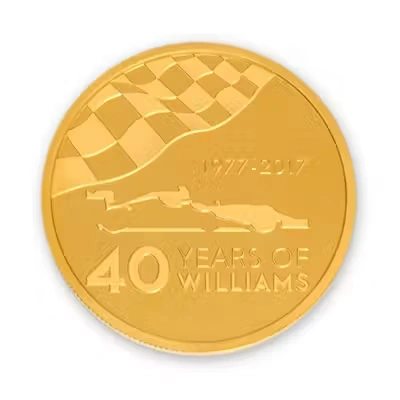
Leading precious metal asset firm, Rosland Capital today unveiled their latest coin collection – designed in collaboration with Williams Martini Racing – to mark the famous British racing outfit’s 40th Anniversary celebrations that have been taking place throughout 2017.

Two hundred and forty 2.5oz Gold Coins & six hundred and forty 2.5oz Silver Coins, each bearing the ’40 Years of Williams’ logo, are being specially produced to contribute to the ongoing celebrations around this landmark anniversary for one of the most successful racing teams in the history of Formula 1. Founded by Sir Frank Williams, the Grove-based team has won 16 FIA Formula One World Championship titles in its decorated history – nine for constructors and seven for drivers – and is the third most successful team on the F1 grid.
This beautiful, limited-edition set of 2.5oz gold and silver coins – of which only 240 will be on sale – is only available from Rosland Capital. The gold 40mm diameter coin is 999.9 fine gold, while the 50mm silver coin is 999.0 fine silver. Both coins are legal tender and bear a portrait of Her Majesty Queen Elizabeth II on the obverse. These collectors’ items are specially minted as proofs, their highest level of quality, by the Commonwealth Mint.
A silver coin is included at no charge with the purchase of each gold coin. Each set comes in a presentation box with a numbered certificate of authenticity. Silver coins are also available separately in a limited edition of 400.
The limited number of coins created mark them out as timeless collectors’ items for any true Williams Martini Racing and F1 fan. Each individually crafted coin is minted by the U.K-based Commonwealth Mint and celebrates the enduring legacy of one of the most iconic racing teams of all time.
Rosland Capital CEO, Marin Aleksov, was delighted to unveil this new range of coins to mark Williams’ 40th Anniversary: “Williams has become synonymous with success, innovation and courage throughout its glorious history in Formula 1. As such, we are thrilled to be able to contribute to the ’40 Years of Williams’ celebrations. We wanted to reflect the same level of quality and detail that goes into everything Williams does in these coins, something that I feel has been achieved via the expert…
For more information, please visit https://www.roslandcapital.com/f1 or call 1-844-754-1349 for the United States and 0800 902 0000 for the United Kingdom. General questions about purchasing gold? Visit our FAQ page.
About Williams
Williams is one of the world’s leading Formula 1 teams. It exists purely to race in the top echelon of motor racing, where it has been winning grands prix for more than three decades.
The Williams name has been synonymous with top-level motorsport since the 1960s. After running teams on the sport’s nursery slopes, team patron Frank Williams founded Frank Williams Racing Cars in 1966 and entered F1 in 1969 with his friend Piers Courage behind the wheel.
Frank quickly earned a reputation as one of the industry’s more determined individuals and, after selling his controlling interest in his original team, he established Williams Grand Prix Engineering with British engineer Patrick Head in 1977. They built their first car, the FW06, the following year and the team immediately went from strength-to-strength.
Williams has since won 16 FIA Formula One World Championship titles, nine for constructors and seven for drivers, and is the third most successful team on the grid.
Rosland Capital Releases Limited Edition Ayrton Senna Coins
June 5, 2017
Late last month, Rosland Capital unveiled a special silver and gold coin collection in commemoration of legendary F1 racer Ayrton Senna. The limited edition coins were unveiled at the 2017 Formula 1 Monaco Grand Prix.
The coin collection was designed in collaboration with the Ayrton Senna Institute and includes six 30 oz gold coins in honor of the 30-year anniversary of Senna’s win at Monaco. Also included in the limited edition collection are 180 2.5 oz gold coins and 300 2.5oz silver coins. The coins are individually crafted and minted by the Swiss firm, Pamp S.A., and bear the iconic image of Ayrton Senna. A part of the coin proceeds will be given to the Ayrton Senna Foundation.
The coin collection was presented by Rosland Capital CEO Marin Aleksov, who said that the company was honored to be included in the celebrations of the 30th anniversary of Ayrton Senna’s win at Monaco.
For more information, go to https://www.roslandcapital.com/f1
Gold: The Big Surprise
May 2, 2017
The big surprise in the world of gold thus far this year has been the metal’s lack of price volatility. This despite:
- All the uncertainty associated with a new, and somewhat maverick, president in the White House compounded by a dysfunctional and highly political Congress,
- The coming withdrawal of Britain from the European Union and the possibility the French will follow suit by pulling out of the EU too,
- The rising tensions between Russia and the United States on two fronts (Ukraine and Syria),
- And, most recently, rising North Korean bellicosity, the real possibility the North will gain nuclear arms capability, and the risk of all-out war (accidental or intentional) in the East Asian region.
There was a time when any one of these developments would have been enough to send the gold price skyward. But, apparently, no longer.
Instead, the gold market seems to shrug off these developments, keeping its eyes focused on the tenor of U.S. monetary policy, particularly the prospect for interest rates.
More precisely, what the gold market is really interested in these days is the “real” or “inflation-adjusted” interest rate. Even if the Federal Reserve boosts its Fed-funds policy rate, say by a quarter percentage point, if inflation expectations rise by more, this combination spells a more expansionary (or less restrictive) monetary policy.
Taking this a little further, business-cycle indicators – say, housing starts, employment data, consumer spending, or industrial production, for example – that point to a slower-growing economy, lead traders and investors to expect more accommodative (or less restrictive) monetary policies with lower real interest – and therefore higher gold prices.
Of course, the opposite is equally true – a stronger economy allows the Fed to raise nominal interest rates. But, so long as these higher rates are exceeded by rising inflation expectations, in actuality, lower or even negative real rates will be supportive of a rising gold price.
We have long espoused the view that the U.S. economy is caught in a long-term multi-year period of secular stagnation characterized by slower than normal economic expansion with disappointing employment and wage growth for many. Unless economic policy-makers and politicians recognize this reality, they will err on the side of excessive monetary growth with lower real interest rates – a favorable mix for gold investors but not a recipe for maximum prosperity for America.
Surprise, Surprise: Gold Moves Higher
March 21, 2017
By: Jeffrey Nichols
Surprise, surprise! Despite last week’s move by the U.S. Federal Reserve, America’s central bank, to tighten monetary policy a notch, gold prices surprised many observers of and participants in the gold scene, even those who had expected the quarter-point increase in short-term interest rates would be sufficient to knock the metal into a still-lower trading range under $1,200 an ounce.
After all, higher interest rates are widely perceived as a negative or bearish influence on the gold price. But, as noted below, it is really the notional real “inflation-adjusted” rate of interest, not the “nominal” rate as might be quoted by a bank or other lender.
Not only did the Fed dial up short-term rates by a quarter percentage point, it suggested further tightening later this year and next, depending on economic performance and inflationary tendencies later this year. Yet, contrary to popular expectations, gold prices still moved higher despite the Fed tightening.
It just might be that inflation expectations are suddenly on the rise, as financial markets get a grip on the Trump administration’s economic and trade policies.
Having fallen briefly a tad under $1,200 an ounce in the days leading up to the Fed’s policy announcement last Wednesday, the yellow metal ended last week at $1,230 an ounce – a gain of some 2.5 percent over the prior week and 15 percent from year-end 2016.
As trading resumed this week in world gold markets, it now looks like gold prices are set to move still higher. In the short run – measured in hours, days, and weeks – hedge funds, commodity funds, and other institutional speculators are both reacting to and contributing to the market’s upward momentum.
Traders don’t want to miss out on a good party, let alone a major move up into a higher bracket. As they wade deeper into the market, stepping over and breaking through important trading levels, the market’s upward momentum is attracting still more buying, advancing the rally still further. Before long, a growing number of traders will see more than just another rally but a firm resumption of the long-term bull market.
Indeed, the market is now at an important juncture with key fundamentals and technical trading setting up the possibility of a self-fulfilling prophecy where buying begets more buying – all of which is fueled by increasingly bullish fundamentals.
First and foremost, despite the rise in nominal interest rates, as “real” or “inflation-adjusted” interest rates continue moving lower, gold looks increasingly more attractive to investors, large and small, around the world.
In other words, as inflation expectations rise, the real rate of interest moves lower and lower – making gold look increasingly more attractive. And this, along with technical factors and market psychology, is pushing gold prices higher.
Interest Rates, Inflation, and Presidential Issues Point Up for Gold
February 16, 2017
By: Jeffrey Nichols
Gold prices of late have been testing support just under the market, if you will, preparing for a healthy rally into higher territory.
As I see it, a relatively small group of hedge funds and institutional speculators have been calling the tune for gold, trading the recent range, buying on dips, selling on rallies, and gradually adding to their physical holdings – a behavioral pattern we expect will continue within a rising trading range – at least until a price well above the $1300 an ounce level is established.
Contributing to support under the market, price-sensitive Asian traders continue to bottom feed, accumulating bullion for the billions of gold-friendly households in their region with cash to spend.
Meanwhile, short-term hour-to-hour and day-to-day price action has been governed by the latest news with respect to interest rates, inflation, the dollar, and President Trump’s issues in the White House.
Real Rates Matter Most
With respect to prospective interest rates, a growing number of financial-market participants believe an increasingly hawkish Fed will vote for a quarter-point hike interest-rate hike as early as March when the FOMC, the Fed policy-setting committee, next convenes.
Conventional wisdom suggests that rising interest rates should be bullish for the dollar and bearish for gold.
But while nominal interest rates may be rising in the next few weeks and months, real “inflation-adjusted” interest rates are already falling, as evidenced by rising inflation rates – note this week’s consumer price (CPI) and producer price (PPI) reports both rising 0.6 percent for the past month.
In my view, an accelerating U.S. consumer-price inflation rate will outpace any increase in nominal rates brought about by the Fed – a trend that will contribute to record high gold prices in the next few years.
For the immediate future, the next few weeks, confusion at the White House and a weakening President may also benefit gold if Trump’s more radical policy initiatives lose support among Republicans in the House and Senate.
Fasten Your Seat Belts
Looking further forward, possibly even by the end of this year, there is a real chance the price of gold will recover much, if not all, of the ground lost since hitting its all-time high near $1,924 an ounce in September 2011.
For many years now, gold – real physical metal, not just paper proxies – has been moving from weak hands in the West to strong hands in Asian markets. When gold heats up, I expect a shortage of available supply, reflecting this geographic shift in ownership, will trigger a bidding war for gold, driving prices to unimaginable heights within the next few years.
Another significant source of physical gold demand – with significant price consequences – results from the recent relaxation of Islamic Sharia law making possible investment in physical gold by millions of religious Muslims around the world who, until now, eschewed gold. Many have great wealth – but strict interpretation of Sharia law has heretofore limited or prevented their investment in the metal. Within the next few years, we think Muslim demand could reach 500 tons a year, placing these investors on a par with China and India as a long-term sponge for gold.
Take Comfort in the Long Term
January 4, 2017
By: Jeffrey Nichols
Gold bulls, ourselves included, have suffered a disappointing year. Rather than ending 2016 on a strong note, the biggest surprise to many was the failure of gold to surge higher in the wake of Donald Trump’s election as the next president of the United States.
For a moment, as the polls closed on Election Day, we thought Trump’s victory would create the sort of uncertainty upon which gold typically thrives. Instead, contrary to expectations, Wall Street has since zoomed to new all-time highs and gold has disappointed fans of the yellow metal.
One thing is for sure: In the short run, financial markets – including gold – dance to their own tune and short-term forecasts, even when based on serious analysis, are often wrong.
As I’ve said many times, I don’t like making short-term predictions about the future price of gold. People who do are usually very lucky or very wrong.
That said, although a low probability, I think there is a real chance this year that the price of gold will recover much of the ground lost since hitting its all-time high near $1,924 an ounce in September 2011.
Over the long term, however, fundamentals do matter . . . and, over the long term, we feel increasingly comfortable with our long-term bullish forecast of gold prices rising to unimaginable heights. If not this year, the chances of gold soaring will rise from year to year.
Indeed, despite the yellow metal’s recently disappointing performance, the price of gold is likely to zoom much higher in the years ahead, perhaps doubling or even tripling from recent lows by the end of president-elect Trump’s four-year term.
Here are some of the reasons supporting my audacious long-term forecast:
Strong hands: In recent years we’ve seen a shift in gold ownership from weak hands to strong hands, from American and European hedge funds and other institutional investors to Asian hoarders – both private-sector buyers and central banks.
When sentiment in Western markets turns more favorable toward gold, those investors and speculators who were quick to sell or short the metal for a quick profit on the way down will find it difficult to restore their long positions except at increasingly higher prices.
In other words, a shrinking supply of readily available gold will be insufficient to satisfy rising demand for gold from many of those who not long ago were eager sellers.
Moreover, the contribution to new supply coming each year from global gold-mine production is now shrinking – and is set to continue declining for the next five-to-ten years. Gold mining is a high-risk endeavor with the time from exploration, development of new discoveries or expansion of existing mines, and eventual start of production, a multi-year endeavor.
Asian demand: China and India are, by far, the world’s biggest buyers of gold with each country’s annual demand near or above 500 tons. Despite year-to-year fluctuations, their voracious appetites for gold will continue to grow as their economies grow and their middle and wealthy classes expand.
China’s government is intentionally pursuing pro-gold policies, taking concrete steps to develop its domestic gold-market infrastructure by encouraging the development of domestic physical and futures markets. And, its central bank, the People’s Bank of China, has bought, on average, roughly 15 tons each month in the last dozen or so years.
India is a much different market for gold. The yellow metal is deeply embedded in Indian culture and religion – and serves as a vehicle for saving and accumulating wealth in lieu of distrusted Western-style financial institutions. Over the years, the government has tried to discourage gold demand by imposing onerous regulations and import taxes – but the more it tries the more people want to hoard the metal.
The Indian government’s recent effort to gain more control over its banking system by recalling 500 rupee and 1000 rupee banknotes will further damage confidence in the government and financial sector – and raise long-term interest in gold as a store of value.
Prospective Islamic gold demand: Another potentially significant source of demand for the metal – with possibly huge price consequences – is the recent relaxation of Islamic Sharia law with regard to gold and the associated regulatory changes that will make possible investment in physical gold and other related assets by millions of religious Muslims around the world who, until now, eschewed gold. Many have great wealth – but strict interpretation of Sharia law has heretofore limited or prevented their investment in the metal.
Gold Still Set to Soar
December 15, 2016
Contrary to our expectations and nearly everyone else’s who pays attention to the price of gold, the yellow metal has, since Election Day, shed nearly 15 percent of its value in U.S. dollars.
According to the pundits who pay attention to such matters, the election of Donald Trump should have pulled the rug out from under stock prices, hammered the dollar against other major currencies, and propelled gold sharply higher.
But once again the pundits have been proven wrong: Stock prices on Wall Street have zoomed to new historic highs and gold has, once again, disappointed.
Despite this failure to perform, our long-term positive outlook for gold remains unchanged.
In retrospect it is easy to see what happened: Investors and speculators expected a shift in fiscal policy – regardless of the election results – with increased government spending, rising Federal debt, and higher interest rates.
The expected rise in Federal spending gave Wall Street a boost up despite expectations of higher interest rates, expectations that might have otherwise been a drag on equities.
At the same time, a spate of favorable business indicators raised the probability the Federal Reserve would soon shift to a less accommodative monetary policy. Higher interest rates boosted the U.S. dollar’s value in world currency markets . . . and, in turn, a stronger dollar depressed the dollar price of gold.
Like a self-fulfilling prophecy, hedge funds and other institutional speculators were quick to buy equities and sell gold once it looked like a quick buck could be made on the trade – with more players jumping in once it looked like these trends were continuing.
One thing is for sure: In the short run, financial markets – including gold – dance to their own tune and short-term forecasts, even when based on serious analysis, are often wrong. Hence, to minimize risk and assure lasting returns, we advocate diversification and the inclusion of physical gold in every investor’s portfolio.
Over the long term, however, fundamentals do matter . . . and we feel increasingly comfortable with our long-term bullish forecast with gold prices rising to new heights.
Indeed, despite the metal’s recent disappointing performance, the price of gold is likely to zoom much higher in the years ahead, perhaps doubling or even tripling from recent levels by the end of the president-elect’s four-year term.
Contrary to the experience of the past few years, gold’s long-run prospects are less dependent on U.S. monetary and fiscal policies or on interest rates and the dollar . . . and more dependent on demographic trends in China and India, trends that virtually guarantee growth in demand from the expanding middle and wealthy classes in these two gold-friendly countries.
In addition, less certain – but potentially very significant for boosting the metal’s future price – is the very recent relaxation of Islamic Sharia law and the associated regulatory changes that will make possible investment in physical gold and other related assets by millions of religious Muslims around the world.
Rosland Capital Visits Abu Dhabi for Final F1 Event of 2016
December 8, 2016
The Abu Dhabi Grand Prix marked the end of the 2016 FIA Formula One season. Rosland Capital and CEO Marin Aleksov were there to present the newest gold and silver coins of the Officially Licensed Formula 1 Coin Collection. To commemorate one of the most glamorous and exotic races, a .25oz gold coin, 5oz coin in gold and silver, and 5kg gold coin were shown to Formula 1 fans on November 25 in the Formula One Paddock Club. Aleksov said, The reception we have received from the F1 community to the coin collection this year has been overwhelming in its positivity. We are proud to be associated with Formula 1 and it’s a real thrill to end our first year in the sport on a high here at the Yas Marina Circuit.” More on Rosland Capital in Abu Dhabi.
To view the 5kg coin and the scene in Abu Dhabi, check out photos from Rosland Capital on Instagram.
Audio: How Will the Presidential Election Results Impact Financial Markets?
November 17, 2016