
Rosland Capital on Gold and Other Precious Metals
June 2024 News Digest
June 25, 2024

-
Iraq has reportedly increased their gold reserves to over 145 tons, according to the World Gold Council.
-
The U.S. Mint announces that the 2024 American Eagle 1 ounce gold uncirculated coin is now available for order.
-
Isaac Newton’s efforts to eliminate England’s massive coin counterfeiting inadvertently led to the country adopting the gold standard in 1695.
-
A metal detectorist in Norway recently discovered a gold coin issued by the Byzantine Empire.
-
A nearly complete date set of 19th century gold dollar coins has been revealed by Matador Rare Coins, after spending over 100 years in a vault.
-
In 2019, the Australia Post and Royal Mint released 26 limited-edition legal tender dollar coins as part of the “Great Aussie Coin Hunt” – now a collector reveals some of the super rare versions that can be worth upwards of $450.
-
The 2024 Maine Innovation dollar recently made its debut as the third release of the U.S. Mint’s American Innovation $1 Coin Program.
-
The U.S. Mint recently released a new U.S. Army 1 ounce silver medal, the latest in its series honoring the nation’s armed forces.
Gold – Does the Election Matter?
November 2, 2016
By Jeffrey Nichols
Of course, elections matter. But regardless of who moves into the White House this coming January, gold prices are set to zoom in the years ahead – in my view, more than doubling during the next President’s term.
What many Western investors – particularly Americans – still fail to realize is that investment demand for gold knows no borders. Indeed, it will be the growth in physical demand for gold – from India and greater China – that drives gold prices to unheard of heights over the next several years.
Political and social developments – especially the growth in middle classes with investible incomes in these countries – will be more important than who’s occupying the White House.
But short term, what matters most to gold-price volatility during the run-up to next week’s vote is uncertainty:
- Uncertainty about Secretary Clinton’s legal situation and the on-going FBI investigation;
- Uncertainty about prospective trade, monetary, and fiscal policies depending on which candidate is elected;
- And uncertainty about financial-market and economic prospects under one or the other candidate.
We can only speculate how gold prices might react to the election of one or the other candidate.
Clinton is viewed as the candidate of the status quo – with little change in policies from the Obama Administration and, unless the Democrats gain control of the Congress, four more years of political gridlock in Washington.
My guess is that Wall Street and foreign stock markets would be relieved by a Clinton victory, with equity prices posting brief short-term gains, and gold giving up the small gains it registered in the days immediately prior to the election.
On the other hand, Donald Trump is viewed as an unpredictable candidate whose policy proposals may be perceived as arbitrary and capricious.
His tough, protectionist, anti-trade stance could trigger selling on Wall Street and equity markets around the world – pushing the global economy into recession, undermining the dollar, and boosting safe-haven demand for gold.
At the same time, Trump’s maverick behavior and his scary talk about prospective U.S foreign policy – with respect to relations with allies and foes alike – raises perceived geopolitical risks and could trigger a rush into gold.
Although the election is less than a week away, there remains the possibility of more surprises – from the FBI, from the Donald Trump camp, or even from the Clinton campaign – with implications for gold-price volatility in the days ahead.
Gold – The Latest Surprise
October 6, 2016
Gold has once again surprised. This time, news from “outside the market” set in motion a chain reaction that knocked gold for a loop.
First, the British confirmed the country was withdrawing from the European Union . . . and sooner than most had expected. This triggered an instant devaluation of the British pound and a corresponding rise in the U.S. dollar in world currency markets.
Not surprisingly, as the dollar rose, gold took it on the chin, as it most often does when the U.S. currency appreciates.
At the same time, contributing to the dollar’s recent appreciation has been a string of favorable U.S. economic statistics that, in turn, raised expectations the Fed might sooner rather than later raise short-term interest rates, perhaps even by yearend.
Once the dollar started its ascent, gold’s short-term fate was sealed . . . and its downward decline was further fueled by technical selling at key chart points, much of it computer driven, that is to say without any human intervention!
Now, most immediately, having shed some $75-to-$100 an ounce in a matter of days, we are seeing some technical support and bargain hunting as gold tests the $1250 level.
If this key chart point holds, as I think it will, gold could soon be on the upswing again. But if it can’t hold, watch out for another possible washout prompted by a further wave of technically-driven speculative selling that takes gold down another notch before a long-lasting upswing gets underway.
Giving us some comfort has been the observation that much of the recent selling has come from large-scale speculators operating in futures and forward dealer markets. Meanwhile, physical demand from retail investors and, most importantly, hedge funds and other large-scale institutional investors has remained firm.
Lately, as gold prices have dropped, these institutional players have added to their holdings via exchange-traded funds (ETFs). Gold ETFs now stand at over 2000 tons, near the highest level in over three years. I expect this market segment will continue to grow – especially as some fund managers seek bargains at recently depressed price levels.
Adding to my sanguine view of the recent price decline has been the absence in recent days of Chinese participation in the market – either as buyers or sellers. China is the world’s largest gold market – and ordinarily one might have expected the Chinese to easily absorb much of the gold sold this past week in the United States and European markets.
When Chinese investors return, at whatever price level, they’ll sense a bargain. And, their buying alone should be enough to stabilize the price and re-launch gold on its long-term upward trajectory.
The Lady Liberty Series from Rosland Capital, MTB and PAMP
September 23, 2016
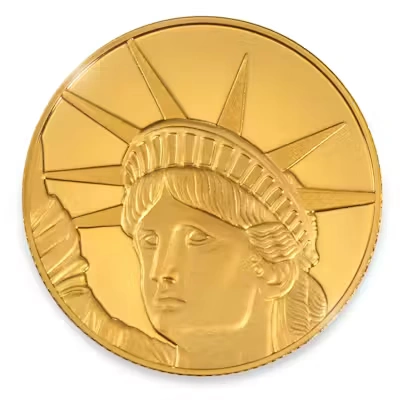
Rosland Capital, through MTB and PAMP is excited to offer the Lady Liberty series. Three different design in this series were created to show the beautiful Statue of Liberty in gold coin form. The coins are sold exclusively by Rosland Capital and can be found here.
Jeffrey Nichols Talks with GoldSeek.com Radio
September 22, 2016
Gold and the Interest Rate Disconnection
September 21, 2016
By: Jeffrey Nichols
I don’t like to make short-term predictions about the price of gold – people who do are usually very lucky or very wrong.
But the times are changing . . . and we are entering a new phase in gold-price action where expectations of Fed interest-rate policy becomes less important and other, more bullish, gold-price drivers come to the fore.
Just look at the past few weeks or even, for that matter, the past year: The day-to-day fluctuations in the price of gold have been almost entirely a reflection of the gold-market’s expectations of prospective Federal Reserve interest-rate policies.
More fundamentally, news of an improving economy triggered expectations that the Fed would raise interest rates by 25-basis points at its September Federal Open Market Committee meeting . . . and expectations of higher interest rates, even a meager quarter-percent rise, predictably brought gold prices down.
Meanwhile, news of an economy struggling to maintain any upward momentum had the opposite effect: Expectations that the Fed would dare not tighten by raising rates supported brief rallies in the price of gold.
But, to my mind, this way of thinking about gold-price prospects is naïve. Indeed, the belief that a 25-basis point hike in the Fed funds rate, the key policy instrument of the central bank, would send gold prices sharply lower makes no sense.
At the risk of oversimplifying, prices of other financial instruments, financial instruments that also compete with gold, fluctuate far more than a quarter-percentage point, not just from day-to-day but even intra-day!
Moreover, large-scale fund managers, institutional speculators, central-bank reserve managers, even retail investors buy and sell gold with expectations that prices are going to go up or down much more than a meager 25-basis points – or even several percentage points – in a fairly short time span. Importantly, they also buy and hold gold for a variety of reasons, reasons that cannot be easily quantified such as portfolio diversification, financial insurance, inflation protection, etc.
Most important, much of the world’s gold trading and purchases, whether for investment, jewelry, cultural or religious practices, takes place in China, India, and other Asian countries – and participation from this region is hardly governed by U.S. monetary-policy considerations.
But, whatever the news in the weeks and months ahead, I believe the Fed will have little room to raise interest rates by anything more than a token increase, if that. What’s more likely, the U.S. and global economic news will continue to disappoint – and this could be enough to support a rising gold price.
Another near-term catalyst could be seasonal buying from both India and China, the world’s two-biggest gold-buying nations. Gold demand in India has a strong seasonal component, reflecting the annual monsoons, the associated rise in agrarian incomes, and the autumnal festivals beginning in September.
Gold demand in China also typically picks up late in the year in anticipation of the Lunar New Year holiday in January 2017. In addition, once it is clear we are in a rising market, Chinese gold buyers are likely to chase the market higher, fearful of missing out on still-attractive prices.
Rosland Capital Featured on Formula1.com
September 2, 2016
In June, Rosland Capital announced the limited edition Formula 1 coin collection that would commemorate the circuits of the 2016 FIA Formula One World Championship. The collection includes .25 oz gold coins that celebrate the British, Italian and United States Grands Prix, 2.5 oz gold and silver coins that list each round of the championship, and a kilo coin celebrating the 2016 Formula 1 season.
Head over to the F1 website for more information on the Rosland Capital collection.
Gold Reckoning Ahead
August 16, 2016
Although the price of gold is up some 25 percent so far this year, the metal still remains 30 percent below its all-time high of $1,924 registered in September 2011 – so there’s still plenty of room overhead for the price of gold to move higher – as I think it will – without excessive resistance.
I’m no gold bug – but I have been “super bullish” on gold for the past few years. Now, I think the yellow metal’s day of reckoning is quickly approaching.
A decisive break above $1,400 an ounce could be just around the corner – and, to my mind, would signal the start of gold’s next major advance.
Indeed, it looks like gold is setting itself up for a major price advance that will see the metal challenge its previous historic high in the next few years – and, longer term, continue into still higher virgin territory.
Near term, gold prices will continue to be “data driven” – that is dependent on the flow of economic news as it affects expectations of Federal Reserve interest-rate policies. Good news leads to expectations of a near-term rate increase and a weaker gold price. Bad news leads to expectations of continued near-zero short-term rates and a higher gold price.
But, whatever the news in the weeks and months ahead, I believe the Fed will have little room to raise interest rates by anything more than a token increase. What’s more likely, the U.S. and global economic news will continue to disappoint – and this could be enough to support a rising gold price.
Another near-term catalyst could be seasonal buying from both India and China, the world’s two-biggest gold-buying nations. Gold demand in India has a strong seasonal component, reflecting the annual monsoons, the associated rise in agrarian incomes, and the autumnal festivals beginning in September.
Gold demand in China also typically picks up late in the year in anticipation of the Lunar New Year holiday in January 2017. In addition, once it is clear we are in a rising market, Chinese gold buyers are likely to chase the market higher, fearful of missing out on still-attractive prices.
In past Commentaries, I have written of the shift in gold ownership to “strong hands” in Eastern markets (led by China and India) from “weak hands” in Western markets (led by the United States and Europe). This tendency has allowed for an orderly recovery in the price of gold over the past few years.
Now, however, we are beginning to see rising competition between Western buyers and Asian buyers – and greater day-to-day price volatility.
Key to the bullish outlook, as Western investors and institutional speculators collectively decide that it would be good to own more of the metal, they will find a shortage of “available supply” – with buyers increasingly having to pay a higher price to encourage sellers to part with their metal – and probably much higher than the past historic peak of $1,924 an ounce reached in September 2011.
Importantly, several thousand tons of gold have gone into the Asian region in recent years . . . yet not one ounce of gold will come out during the next few years despite the much higher prices that lay ahead.
Gold: Waiting for Wall Street
July 21, 2016
By: Jeffrey Nichols
Although gold prices have had some difficulty sustaining recent gains above the $1365 per ounce level, the metal has nevertheless registered just about the best performance across virtually all investment classes over the past six or seven months.
Over the past half year, the metal has rallied some 25 to 30 percent – far better than the major stock-market averages that have received more favorable attention from the financial press for reaching new all-time highs.
The reason I mention this is that gold has been trading inversely to equities – and, consequently, the yellow metal stands to gain much when Wall Street tumbles, an outcome that seems increasingly likely as world stock markets edge higher despite widespread expectations of slow economic growth and disappointing corporate earnings, at least for the next year or two from one country to the next.
In recent years, a small number of hedge funds and other large-scale institutional investors have been responsible for the major cyclical price swings in gold and, to a lesser extent, the broad stock-market indexes.
This was especially true in the historic run-up in the price of gold to its all-time high just over $1924 in early September 2011. And, this has been just as true – but in the opposite direction – as gold fell back to last year’s lows. Since then, it has been institutional buying that has fueled gold’s recovery and it has been a relaxation in this institutional demand that has triggered the occasional gold-price correction.
Think of it as a Herculean battle of giants: When stocks are doing well and registering new highs, some investors will abandon gold and buy stocks, for fear of missing the chance to capture prospective gains on Wall Street. We have seen the opposite as well: When equity markets lose their upward momentum, institutional investors sell stocks and pile into gold. We know this from the weekly gold exchange-traded fund (ETF) statistics, which analysts like myself consider a reliable proxy for gold investment demand from large-scale players.
Of course, many factors influence the price of gold – some of which also influence world equity markets and may account for the negative correlation between the two asset categories. Our clients know we have been “super bullish” for some time now with great expectations for gold. We remain so, in part because we believe, based on current and historical price-to-earnings ratios, that ordinary equities are greatly overvalued.
What makes us “super bullish” is more than just expectations of a major bear market on Wall Street. In the past, we have written of the shift in gold ownership to “strong hands” in Eastern markets (led by China and India) from “weak hands” in Western markets (led by the United States and Europe).
As demand turns more forcefully toward gold and Western investors collectively decide that it would be good to own more of the metal, they will find a shortage of “available supply.” They will discover many of the buyers in Asia don’t want to sell except at much higher price levels, probably much higher than the past historic peak of $1924 an ounce reached in September 2011.
The trigger could be a decline in equity prices on Wall Street and around the world, a decline that sends investors scurrying for protection, protection that only gold can provide.
Rosland Capital Debuting F1 Coin Collection at British Grand Prix
July 8, 2016
Rosland Capital is at the British Grand Prix today unveiling the new Formula One coin collection that went on sale three weeks ago in the United States. The limited edition 1kg, 24 karat gold coin was shown to reporters at the Grand Prix on Friday. The coin has a melt value of more than $40,000 and only 15 of them have been made.
Rosland Capital’s CEO Marin Aleksov said, “Fans feel a sense of invested interest in this, it’s like buying a share in F1.”
To learn more about the collection, click here.