
Rosland Capital on Gold and Other Precious Metals
April 2025 News Digest
April 23, 2025
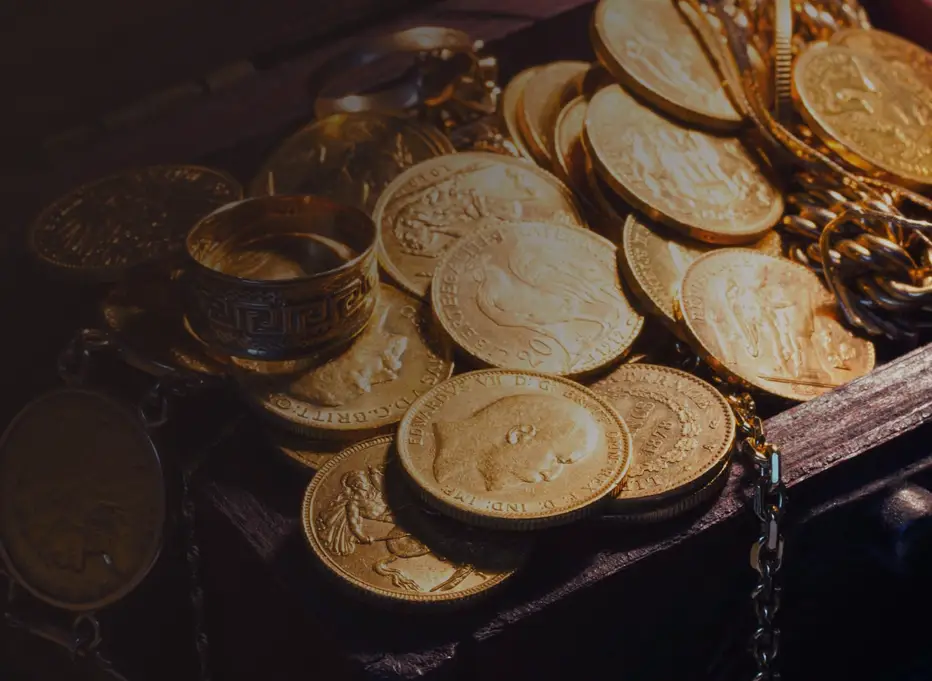
- This year’s National Coin Week (April 20-26, 2025) theme celebrates the connection between coins and pop culture, featuring icons like Superman, Elvis, and Homer Simpson.
- A collection of 15,000 rare coins dubbed the “Traveller Collection” and hidden for decades, will be auctioned off for an estimated $100 million. The first auction of 15 will begin on May 20.
- Alba Mineral Resources sold a 1oz Welsh gold coin for £20,000, demonstrating the value of Welsh gold and boosting confidence in their North Wales mining project.
- A Czech woman stumbled upon a ceramic pot containing over 2,150 silver coins from the early 12th century, a discovery hailed as one of the most significant of the decade.
- The Royal Mint created 5kg coins featuring Paul McCartney, which were polished for days and crafted with input from Paul and his team. These coins were auctioned by Stack’s Bowers and sold for $753,600.
- Four legendary U.S. coins—the 1794 Flowing Hair Dollar, 1933 Double Eagle, 1913 Liberty Nickel, and 1804 Draped Bust Dollar—have each fetched millions. Their value lies in rarity, mystery, and history, turning small pieces of metal into priceless artifacts.
- The rarity, mystery, and history of four legendary U.S. coins – the 1794 Flowing Hair Dollar, 1933 Double Eagle, 1913 Liberty Nickel, and 1804 Draped Bust Dollar – have transformed these small pieces of metal into priceless artifacts, each fetching millions at auction.
- A construction worker in Glottertal, Germany, discovered around 1,600 medieval coins (circa 1320 AD) during a piping project. This major find, sufficient to buy 150 sheep at the time, included coins from German, French, and Swiss mints.
- Alabama Governor Kay Ivey signed SB130, making gold and silver legal tender. This aligns with the U.S. Constitution and is part of a Sound Money Defense League-supported national effort. Alabama is the fifth state to enact such legislation in 2025.
- Hong Kong numismatic auctions by Heritage and Stack’s Bowers saw strong results for East Asian coins, including a silver “Mukden Tiger” dollar selling for over $1 million and a gold 1906 K’uping tael for $528,000, attracting global interest in Chinese, Japanese, and other regional coins.
- Metal detectorists in Breaza, Romania, unearthed 19 ounces of silver Dacian artifacts (bracelets, brooches, etc.) from 500 B.C. This significant discovery provides insight into elite ancient Dacian culture.
- Spectres presents a limited edition (1,000) 2 oz silver 3D baseball coin for Samoa. This hollow piece features realistic stitching, “Bullion Bombers” branding, and “Home Runs” as serial numbers, making it an innovative tribute to baseball.
- U.S. Mint coin production increased 8.8% in Q1 2025, reaching 1.88 billion with 670.42 million in March. Despite high penny volume, President Trump halted their production, citing wastefulness. The Mint will continue producing Kennedy half dollars and Native American dollars.
Is Inflation “Transitory”?
November 10, 2021
Transitory is a word that has been forced into everyday usage by its continued utterance by US Federal Bank Chair, Jerome Powell. (The Merriam-Webster dictionary definition of the word is: “of brief duration i.e. temporary or tending to pass away. not persistent.”) So is he right in calling current inflation levels ‘transitory’?
The short answer is yes – in part!
Current inflation levels are largely made up of two elements. There is ongoing price inflation, probably running at about 2-3% annually which is generally considered acceptable, but on top of this there is the Covid-19 pandemic-associated inflation which is far higher and indeed is probably ‘transient’ in the true sense of the word.
The real question is how long will this ‘transient’ element of the inflation equation go on? Powell’s arguments are that this is only a short term phenomenon and inflation will revert back to the old 2.5-3% level within a few short months.
However there are others who feel that the inflation problem, admittedly intensified by the pandemic, is far more deep-seated and rates will move higher for longer than the Fed is prepared to acknowledge. Some believe this has been brought on by serious supply-chain problems, although these may eventually be overcome, and that element could be taken out of the headline inflation figure.
How long this will take remains uncertain, though. It could be months before the long-term effects of the current problems are excised from the data.
But there are other underlying elements of the inflation calculation that are deep-seated and could well be reflected in longer term price inflation. Some of these relate to the degrees of debt run up by companies that have used loans, admittedly often at low interest rates and government-supported, in order to stay in business during the pandemic. These companies will need to repay these loans, in addition to financing their everyday running costs as per usual. This could result in price increases that, once in place, may be difficult to reverse.
The most recent calculation of US inflation based on the CPI (Consumer Price Index) sits at 5.4% over the year to September. Many consumers reckon that this understates the true experience of today’s general public.
The next CPI update is due on November 10th and will be closely watched to see if it appears to be getting worse or not.
The September figure is the largest year-on-year increase since July 2008 when the CPI rose to 5.6% and this level could be considered borderline at the point, which becomes gold price positive due to real interest rates moving into seriously negative territory.
Back in 2008 the CPI started to fall after July, and reverted to around 0.1% by the year end, which will be giving the Fed some comfort in its ‘transitory’ forecasts, but the aftermath of the Covid-19 pandemic could put us into a new inflation era. There are thus serious worries that inflation could well move higher through the remainder of the current year and into 2022.
That is until the inflationary after-effects of the virus incidence, and the measures taken to control it, work their way out of the system, which could yet take some time – maybe another year.
The worry potentially facing the markets is could this be the start of an upwards inflationary spiral? If that is seen to be the case, the Fed could begin moves to contain the problem by raising the Federal Funds rate by perhaps as much as half a point or more next year which would be followed across the board. But, in theory, this could begin a major downturn in the equities market.
Market crash warnings abound, which could raise the risk and the Fed may thus proceed cautiously for fear of being accused of precipitating a severe market downturn.
Indeed the Fed may welcome an above-average degree of inflation, as long as this can be kept under control, and thus sit tight without making any anti-inflationary move at all.
by Lawrence Williams

Lawrence (Lawrie) Williams is a highly regarded London-based writer and commentator on financial and political subjects, specializing in precious metals news and commentary. He graduated in mining engineering from The Royal School of Mines, a constituent college of Imperial College, London. He has contributed articles on precious metals to the Financial Times, Sharps Pixley, US Gold Bureau and Seeking Alpha among others.
The opinions expressed in this article are the author’s own, do not necessarily reflect the opinions or views of Rosland Capital LLC or its employees, and do not constitute financial or investment advice or recommendations from the author or Rosland Capital or its employees. The author is compensated by Rosland Capital for his articles.
Rosland Capital Adds New 2.5 oz Silver Coin to British Museum Coin Collection
October 18, 2021
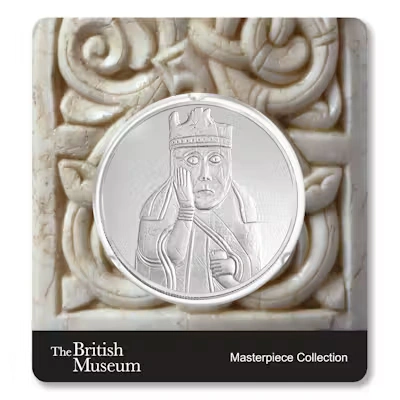
The latest addition to Rosland’s coin collection created in collaboration with the British Museum is this silver Queen – one of the famous Lewis Chess Pieces.
On the obverse side of the coin is Ian Rank-Broadley’s portrait of Her Majesty Queen Elizabeth II and the year of minting – 2021.
These new coins are .999 fine silver, 2.5 Troy oz., legal tender proofs, minted by Swiss-based PAMP SA, one of the world’s finest producers of precious metal coins.
The packaging shows the back of another of the chess pieces, and includes a Certificate Number, statement of metal fineness, weight, proof quality statement, and the signature of the accredited independent Swiss assayer at PAMP.
Gold vs. Silver
October 6, 2021
For the believer in precious metals, the choice of which ones to put one’s faith in is far from simple. While supply and demand fundamentals may be significant in the overall picture – particularly for the more industrially oriented metals – the very fact that this group of metals carries the ‘precious’ tag has tended to generate something of a premium.
All are affected to some extent by movement in the price of gold.
Meanwhile bitcoin, by comparison, looks to me as an asset that equates pretty much to a Ponzi scheme reliant on the unwary being seduced into buying it for any continuing price growth.
Its hugely volatile ups and downs confirm it as a potentially unsafe asset for longer term wealth preservation – at least in the opinion of this writer.
In terms of usage and demand patterns silver and the platinum group metals (pgms) tend to fall nowadays more into the industrial camp – or should – as that is where the most significant part of their demand arises.
This is probably true above all of palladium – and also for rhodium if one also includes the rarer pgm elements.
Here demand dependence relies very much on the ups and downs in the economy, including the automobile market. Palladium/rhodium combination catalyst is a prime constituent of the mandatory exhaust cleaning systems used in new gasoline powered vehicle internal combustion engines in many of the world’s nations.
As environmental concerns grow, so also do the catalytic loadings in the exhaust emission control units, which has been creating supply shortages for the metals and a consequent sharp rise in prices as manufacturers struggle to meet demand.
Platinum at one time used to be the main catalytic element utilized in these emission control systems, but at that time platinum was hugely more expensive than palladium. This may have led, in part, to a substitution of palladium for platinum in the catalytic converters needed for exhaust emission control – a position it has held since.
But a resulting huge palladium supply deficit has led to this pricing position being reversed over the past year or so. So, there is the distinct possibility that platinum could again become a much more significant catalytic metal used in gasoline engine exhaust emission control systems as a potentially now far less costly option.
While such a move may help redress the demand balance and close the price gap between the two metals, a consequent change in the demand balance between the two makes the impact of such a move difficult to quantify. A possible outcome is that the platinum price rises and that of palladium falls to a new equilibrium level.
Platinum does have some other advantages over palladium in likely future demand. It has a more significant role in the jewelry sector and is a key metal in hydrogen fuel cell technology, which is a likely competitor with battery power looking ahead in the currently heavily promoted non-polluting vehicle market. As automotive trends favor electric vehicles going forward, and neither battery electric vehicles (BEVs) nor fuel cell technology utilize palladium, the market for the metal likely will reduce over time. This could possibly lead to a big price fall unless a significant new demand technology for the metal comes to the fore. However this demand reduction may be some years away yet; but long term the price prospects for palladium are likely to weaken accordingly.
Silver is the most difficult to assess, which perhaps accounts for its distinctly mixed price performance of the past couple of years. It retains a perhaps undeserved monetary relationship with gold despite its usage in regular coinage having fallen away virtually to zero.
It also no longer has any significant role in national monetary reserve holdings, yet it retains a psychological price relationship with gold in the eyes of many buyers and commentators, although such ties are beginning to diminish.
The industrial sectors in which silver is utilized are mostly strong growth markets now that its photographic usage has stabilized at a much lower level than in the past. It has a growing demand in photo-voltaics (solar panels), electronics and the medical sector, all of which will support demand growth fundamentals.
If this demand growth – mainly in the ‘green’ sector – continues unabated, there could come a time when demand does exceed supply and the price would advance – as would any metal commodity entering a period of short supply as we have been seeing with palladium – but probably not yet.
Silver is thus perhaps the only one of the subsidiary precious metals that is reasonably influenced by the progress, or lack thereof, of the gold price, but perhaps less so than it used to be. It used to rise further in percentage terms than gold when the latter rose in price, but when the gold price fell the reverse tended to be true.
Silver still has an important place in wealth protection, particularly in India and other parts of Asia where its role in jewelry fabrication remains significant. In Asia, where fabrication mark-ups are low, gold and silver jewelry and artifacts often form part of a family’s disposable wealth held against difficult times. Silver jewelry is also important in the West, but fabrication mark-ups are much higher making it less viable as an easily marketable wealth store.
As there are relatively few primary silver mines in the world – most global production comes as a byproduct from base metals and other precious metals mines – there is relatively little the mining industry can do to mitigate any potential silver shortfall through big production increases of silver alone. A potential short supply scenario may well be what the silver bulls are pinning their long term hopes on. Recently they seem to have been attacking, misguidedly I feel, the big silver short positions held on the futures markets, although the big banks that mostly maintain these also tend to have large stocks of physical metal to balance these short positions out.
In the meantime, silver’s ongoing price relationship with gold, although this may be diminishing in its effects, will likely continue to support the metal at a reasonable price level, but even $30 silver now looks an awfully long way off.
Gold still provides, as it has for thousands of years, a traditional safe haven for wealth protection. Its price seldom rises sufficiently to generate major get-rich-quick gains; it tends to be a slow and steady wealth accumulator protecting the holder against currency debilitation and cost inflation.
In this day and age of buyers having an expectation of rapid and big price gains, it has tended to fall out of favor with the younger generation which seems to be driving the markets currently. However it still remains an important metal for those who have seen it all before and prefer safety over potential short term gains as seen recently in equities and new assets like bitcoin.
These are prone to sharp value markdowns which, if things really go wrong could mean huge decreases in price.. Their potential price volatility reduces their roles as safe wealth protection assets.
With the multitude of conspiracy theories that tend to populate the internet and social media, social media influencers currently play a hugely important role in pushing dubious stocks and stock market-related memes. These are often instigated by those adept at playing to the social media audience.
Regarding bitcoin, we truly are in the midst of a social media-led revolution that may end in tears, and massive losses, when the almost inevitable (in my view) market crash occurs.
Except in a few cases, current equity price levels cannot be justified by real, or even potential, profits – a recipe for financial disaster.
Gold may not be the panacea to counter all the dubious activity promoted by the economically naïve commentators who grace the internet. But it has proved over time that it can ride out such episodes relatively unscathed and come out ahead of the game when buying activity returns to anywhere near normal, and when the market fallout occurs.
In short, one may not make a fortune by buying gold, but it remains one of the safest of the so-called precious metals. Unlike bitcoin, etc. the downside risks tend to be far more limited and it probably remains among the safest ways of protecting what wealth you may have.
Gold has stood the test of time for wealth protection and will likely continue to do so for many years to come!
by Lawrence Williams
Lawrence (Lawrie) Williams is a highly regarded London-based writer and commentator on financial and political subjects, specializing in precious metals news and commentary. He graduated in mining engineering from The Royal School of Mines, a constituent college of Imperial College, London. He has contributed articles on precious metals to the Financial Times, Sharps Pixley, US Gold Bureau and Seeking Alpha among others.
The opinions expressed in this article are the author’s own, do not necessarily reflect the opinions or views of Rosland Capital LLC or its employees, and do not constitute financial or investment advice or recommendations from the author or Rosland Capital or its employees. The author is compensated by Rosland Capital for his articles.
Gold vs. Bitcoin—Tortoise and Hare!
September 29, 2021
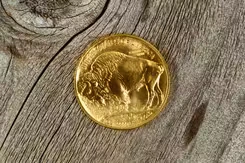
This writer has never been a believer in bitcoin. I sincerely believe bitcoin is a dubious fad which will peter out in the long term and cost buyers of it a considerable amount of money as it returns to its inherent value, which I would put at near zero!
However, I am also one of the first to admit my advice on cryptocurrencies in general has not been borne out by their performance to date and could have cost buyers who have followed my guidance some pretty spectacular gains.
But have I changed my opinion? The answer is a resounding NO.
There is just too much fraud, potential fraud and vulnerability built into the bitcoin environment for it to survive intact in the longer term – or so I sincerely believe.
Gold, on the other hand, has stood the test of time as a wealth protector and (relatively) safe haven in apparent value as supposedly even strong fiat currencies have diminished in value over the years.
This has been the case for hundreds, if not thousands, of years. Gold has not, therefore, been a vehicle generally for spectacular gains, except perhaps in cases of total currency and socio-economic collapse. In other words gold, in effect, has just been an inherently safe form of wealth preservation.
Thus if gold does soar to the $5,000 or $10,000 level beloved of some commentators this would likely be in response to almost total collapse in purchasing power of the dollar, rather than a real rise in the gold price. All things are relative.
A collapse of this kind of magnitude in the prevailing socio-economic system by which we are all governed, would not be something we would want to live through. Be careful what you wish for!
Bitcoin, on the other hand, is, in my opinion, purely a speculative entity dependent on more and more people being sucked into in it by ever more dubious media promotions. It is very much a child of the social media age and may thus appeal to a newer or inexperienced buyer in particular. It is therefore a little disturbing that some respected names seem to have given cryptocurrencies a degree of support and thus credibility.
I’m not saying that all bitcoin, and so-called stable coin, commercial entities are dubious in their antecedents, but some most definitely are. Buyer beware.
But how about the gold tortoise versus the bitcoin hare? Gold offers stability and a limited downside risk, although can be circumspect in moving upwards with any rapidity. Over the years it has served as an excellent wealth protector.
There is not the massive upside potential often attributed to bitcoin – that is unless we succumb to a horrendous economic collapse that would be disastrous for most equities and bitcoin alike.
Bitcoin on the other hand can be hugely volatile, as we have already seen in the cryptocurrency’s short life to date. It can fall 50% in a matter of weeks as it did as recently as in April and May this year and even more steeply as back in its big crash in 2017/18.
It has made a partial recovery recently, but is still a long way off its April high and has recently been moving very erratically in price which suggests all is not well with the asset class in the eye of regulators.
In summary, gold offers relative safety, with the likelihood of at least protecting one against the ravages inflation may have on the purchasing power of the dollar. There is substance behind it in the form of major central bank holdings which will not easily be written off. But its relative stability makes it very much a tortoise – slow to move and to make rapid significant gains.
Bitcoin, though, is very much a hare. It may, or may not, have the potential to provide substantial short term gains or losses, but this writer sees its longer term potential as problematic.
As a digital form of money it is effectively only code held on a computer and thus increasingly vulnerable to today’s ever more sophisticated hackers and fraudsters. Governments don’t like it either, as it can be a way to move funds completely anonymously, something that can benefit tax dodgers and the criminal elements in society.
Thus it is likely to become an ever-growing subject for investigation by regulators that has to be a worry for some of the more dubious players in the market. Any adverse publicity should unsavory activity be exposed could lead to a crisis of confidence in cryptocurrencies in general and a consequent price collapse.
Bitcoin remains, therefore, very much a gambler’s play. But even so, perhaps better safe than sorry. Time has shown that sticking with gold can be a safer bet, and it is my opinion you should only purchase bitcoin if you have money you can afford to lose.
In the Aesop fable, remember it is the tortoise that wins out in the end.
by Lawrence Williams
Lawrence (Lawrie) Williams is a highly regarded London-based writer and commentator on financial and political subjects, specializing in precious metals news and commentary. He graduated in mining engineering from The Royal School of Mines, a constituent college of Imperial College, London. He has contributed articles on precious metals to the Financial Times, Sharps Pixley, US Gold Bureau and Seeking Alpha among others.
The opinions expressed in this article are the author’s own, do not necessarily reflect the opinions or views of Rosland Capital LLC or its employees, and do not constitute financial or investment advice or recommendations from the author or Rosland Capital or its employees. The author is compensated by Rosland Capital for his articles.
September 2021 News Digest
September 15, 2021
-
Get a better understanding of how gold is priced and what the qualifiers are that determine the price of gold according to these 10 factors.
-
A new coin was added to our “Formula 1” coin collection. Weighing at 2.5 oz, this coin is minted by Swiss-based PAMP SA, one of the world’s finest producers of precious metal coins.
-
Lawrence Williams explains his stance on Bitcoin and how it has ultimately affected the Gold market.
-
Does inflation really affect the price of gold and its value?
-
Brush up on your knowledge of Gold IRAs with this article written by our CEO Marin Aleksov.
Do you know the difference between mint state coins and proof state coins? If not, Marin Aleksov gives you everything you need to know!
Gold Price and the Inflation Connection
September 8, 2021
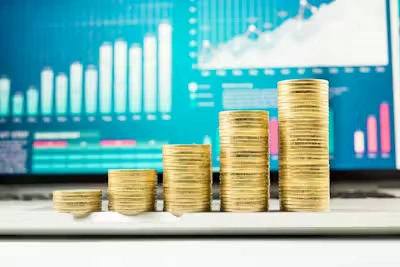
Gold is often considered a hedge against inflation, but that has not always proved to be the case. When real inflation rates experienced by the person in the street and by investment funds are distinctly negative, as they are at the moment, then this tends to be strongly positive for gold.
That is why the latest gold price weakness should not be a longstanding concern for the gold buyer.
Gold is a non-interest generating asset – a fact that is often seen as price negative when the economy is strong and real rates are positive. This tends to make other assets more attractive.
However, if real rates are negative, the reverse is true and gold is seen as a significant protector against currency debasement, holding its value as the buying power of domestic money continues to slip.
For the time being, the US Fed’s Federal Fund Rate is set at 0 to 0.25 percent, and could even become negative as in some European nations (probably unlikely) despite inflation trends seeming to be upwards, while the Fed continues to maintain that current high, and possibly even rising, inflation rates are only ‘transitory’.
Transitory they may well be as the world tries to get to grips with an exit from the economic rigors of the COVID-19 virus pandemic. Meanwhile costs associated with safety precautions will also be rising, and need to be compensated for in rising prices.
This is something of a ‘double whammy’ and a major contributor to cost inflation, which is not always picked up by some of the official inflation data statistics, but is very real nonetheless for the average consumer. These price increases may well be temporary in terms of ever-rising Index data, but prices are also unlikely to fall once increases have been implemented, and the rises may go on for much more time than the Fed had initially thought, as more businesses resume operations.
To an extent at least, the Fed has recognized that these inflationary pressures are likely to go on for longer than it had first suggested. But some well-respected observers have predicted that these pressures will accelerate and get worse before they begin to get better.
Some respite might come due to the new virus wave currently hitting parts of the USA, though, which could well slow the virus recovery situation down a little.
But it has to be recognized that Fed-imposed interest rates are remaining ultra-low while the inflation rate, according to most national data releases, is running at between 4 and 5 percent.
Some observers have suggested the real inflation rate is, in reality, upwards of 10 percent rather than what they see as the government-massaged lower figures announced in official data releases.
Be this as it may, both government data and unofficially calculated inflation statistics all put real interest rates into substantially negative territory and I am not sure why gold has not reacted accordingly and moved up, rather than stuttering as it seems to be at present.
Current buyer psychology, though, could tend towards ignoring even obvious downside risks and equities keep rising, while even the somewhat dubious (in my opinion) bitcoin phenomenon recovers some of its recently lost ground.
This is all something of a two-edged sword. The Fed is enormously reluctant to start raising interest rates until perhaps 2023 for fear of derailing any economic growth we may have been seeing and thereby precipitate a recession.
Interestingly, recent research by a well-regarded metals consultancy – New York’s CPM Group – has shown that buyers are unlikely to move away from gold unless and until real interest rates exceed around a positive 3 percent.
The way things are going at present that point may not be reached for several years yet. So gold may be seen as a good choice for the foreseeable future.
A degree of tapering of the Fed’s bond buying program may provide a short term downside for the yellow metal, but any delay in such could be positive for gold sentiment also. The recent coronavirus infection and mortality rate growth seen in the USA could well see this pushed out beyond current expectations.
If the American pullout from Afghanistan prompts some of the nation’s rivals on the world stage – notably China and Russia – to flex their muscles, then a degree of uncertainty arising from that might be another positive factor in favor of gold being seen as a safe haven.
All in all things thus look positive for the gold price going forwards, although current buying conditions could yet put a damper on the yellow metals’ short term growth prospects.
by Lawrence Williams
Lawrence (Lawrie) Williams is a highly regarded London-based writer and commentator on financial and political subjects, specializing in precious metals news and commentary. He graduated in mining engineering from The Royal School of Mines, a constituent college of Imperial College, London. He has contributed articles on precious metals to the Financial Times, Sharps Pixley, US Gold Bureau and Seeking Alpha among others.
The opinions expressed in this article are the author’s own, do not necessarily reflect the opinions or views of Rosland Capital LLC or its employees, and do not constitute financial or investment advice or recommendations from the author or Rosland Capital or its employees. The author is compensated by Rosland Capital for his articles.
Bitcoin Recovers, Gold Stutters—Nobody Cares
August 25, 2021

A few years ago at a Mines & Money conference in London, I was privileged to listen to a presentation from one of my favorite analysts, Grant Williams of newsletter “Things that make you go hmm” fame, with the title “Nobody Cares.”
The performance of the markets recently, particularly for bitcoin and gold, brings that title particularly to mind, although back then Grant was primarily concentrating on gold as bitcoin had not yet really taken off, making some of its adherents rich beyond their wildest dreams – at least on paper.
The title is even more relevant today, particularly when dealing with bitcoin. In this writer’s opinion, bitcoin has to be one of the biggest scams in the financial marketplace. Some of bitcoin’s capabilities as an anonymous electronic payment system seem to have attracted some of the get-rich-quick crowd among its leading lights, as well as others who see bitcoin as a tool for use in criminal activities, such as money laundering.
This is more than obvious to anyone who researches this market in any kind of depth, yet nobody seems to care!
For those interested in the bitcoin phenomenon, take a look at Substack.com and a particular contributor who styles himself Doomberg.
Many of his articles focus on bitcoin, and its proponents. The writer appears to have conducted a considerable amount of research into bitcoin, and the people behind some of its leading beneficiaries therefrom, and the conclusions are, to say the least, alarming.
Many analysts see the whole bitcoin scenario ending in tears as governments intervene to clamp down on aspects of the cryptocurrency that make it so attractive for money laundering by the criminal fraternity. But don’t bank on it happening! There are too many vested interests now involved in this market.
So why should I, who primarily offers commentary on the precious metals sector, write about bitcoin?
The possible growth in bitcoin’s value, could divert some of the funds that might normally find its way into the precious metals sector, and into gold and silver in particular.
Gold has stood the test of time – thousands of years in fact – as an excellent wealth protector. Bitcoin, on the other hand, is a recent investment phenomenon, and can be hugely volatile as we’ve seen in recent months – and if sentiment and governments move against it, as they well may, it could fall enormously again, decimating putative investment gains.
While the gold price seems to move up and down on positive or negative US data releases and statements from Fed officials hinting at the possible moving forward of its tapering and interest rate raising timetable, I feel the overall prognosis for the yellow metal remains distinctly positive.
A good part of this optimism for gold is based on inflation levels, a topic attracting considerable media attention at present. They are running higher than current interest rate levels, which means real interest rates are currently distinctly negative, and look like remaining so.
Negative real rates are usually seen as positive for the gold price given that gold itself is a non-interest generating asset. So in a financial scenario that could see investors’ assets diminishing in value, relative price stability can be seen as a benefit.
Since the 6th Century BC in Lydia, when it’s believed that gold coins were first used as a form of currency, gold has stood the test of time. Over thousands of years, gold has helped to be a wealth preserver, not a get-rich-quick asset.
A claim bitcoin simply cannot make.
by Lawrence Williams
Lawrence (Lawrie) Williams is a highly regarded London-based writer and commentator on financial and political subjects, specializing in precious metals news and commentary. He graduated in mining engineering from The Royal School of Mines, a constituent college of Imperial College, London. He has contributed articles on precious metals to the Financial Times, Sharps Pixley, US Gold Bureau and Seeking Alpha among others.
The opinions expressed in this article are the author’s own, do not necessarily reflect the opinions or views of Rosland Capital LLC or its employees, and do not constitute financial or investment advice or recommendations from the author or Rosland Capital or its employees. The author is compensated by Rosland Capital for his articles.
Rosland Capital Adds New 2.5 oz Silver Coin to Formula 1® Championship Series
August 16, 2021

This 2021-issue, limited edition proof silver coin celebrates the 2021 Formula 1 Championship. The Grand Prix events in the 2021 schedule, as confirmed 1/1/2021, are listed around the face of the coin, with the dynamic F1 logo in the center.
On the obverse side of the coin is Ian Rank-Broadley’s portrait of Her Majesty Queen Elizabeth II and the year of minting – 2021.
These new coins are .999 fine silver, 2.5 Troy oz., legal tender proofs. All coins in the Formula 1 coin collection are minted by Swiss-based PAMP SA, one of the world’s finest producers of precious metal coins.
The packaging includes a Certificate Number, statement of metal fineness, weight, proof quality statement, and the signature of the accredited independent Swiss assayer at PAMP.
Top 10 Factors Determining Gold Prices
August 10, 2021
Over time gold has served as a form of currency and as a long term hedge against currency depreciation – in other words as a wealth protector without being subject to some of the drivers that occasionally see enormous fluctuations in other asset values.
Thus it can serve as a wealth preserver, but seldom as a huge investment gainer except perhaps in the case where the currency it is being held as protection against collapses. Given that growth in annual gold supply is extremely limited in terms of the overall amount held globally, it is seen as carrying little or no counterparty risk, unlike many other popular asset classes.
Given that gold is priced in US dollars, despite being in demand globally, the US markets probably have a disproportionate influence on the overall dollar gold price. Even though the status of many global economies should impact the world gold price, at the moment the state of the US economy tends to take pride of place in determining global gold price movement, although from time to time other factors do play a part.
For example, a few years ago the huge apparent gold flows from western economies to eastern ones was seen very much as a defining factor in gold price strength – in particular Chinese and Indian demand levels were seen as a major contributory element, but this was perhaps just a key component of the global supply/demand balance.
More recently though it would appear that US Federal Reserve policy, and any assumed, or “guesstimated” changes therein, are the most important global gold price determinants.
The price tends to fluctuate up and down on the media and analysts’ interpretations of usually fairly obscure, and often ambiguous, statements from key Fed officials.
Here are 10 key price drivers that can affect current gold prices:
-
1. U.S. Federal Reserve (and other major Central Bank) announced, or interpreted, policy initiatives.
-
2. Inflation rate assumptions
-
3. Day-to-day US data releases
-
4. Gold ETF inflows and outflows
-
5. Supply/demand fundamentals
-
6. US dollar strength or weakness
-
7. Investment perception (Animal Spirits)
-
8. Central Bank purchases/sales
-
9. Asian demand trends
-
10. Black Swan events
Perhaps these require a little further explanation. I have placed them in what I consider to be the most relevant order at present.
1. and 2. are somewhat interconnected. Many consider gold to be something of an inflation hedge, but see inflation rates as potentially controllable by Central Bank interest rate policies. Central Bank accommodative quantitative easing policies, and the continuation, or cessation of these, and the likely timing thereof, also come into the equation.
The U.S. Federal Reserve, with its regular Federal Open Market Committee (FOMC) meetings, tends to be the highest profile of these and thus their interpreted outcomes can have an undue influence on the gold price. European Central Bank (ECB) statements can also be important here, but tend to have less impact globally. It should be recognized though that the Central Banks tend to be reluctant to raise interest rates substantially for fear of derailing such economic growth there may be, although if inflation is seen as getting out of hand, this could be a policy restriction they may begin to ignore.
In late August there is an even more relevant U.S. meeting held – the annual Jackson Hole Symposium – which also involves the participation of many other global Central Bank heads. Policy pronouncements and agreements made there may thus have a particularly significant impact on global gold prices going forward.
3. US data releases. Increasingly we have been seeing both positive and/or negative effects from regular releases of specific US economic data and we suspect this will continue as far as short term gold price movements are concerned. In particular the markets tend to react one way or the other to releases on unemployment, inflation and industrial perception.
4. Gold ETF flows – These can have a particularly strong influence on the gold price. Most gold investors will remember back to 2012-14, for example, when there were massive outflows from the global gold ETF sector and the metal price plunged accordingly.
Over 3,600 tonnes (metric tons) of gold are currently held in global gold-backed ETFs, roughly equivalent to current annual global new gold production, so inflow and outflow levels from this sector can be hugely significant. Periods of outflow tend to result in lower gold prices as we have been seeing recently in H2 2020 and Q1 this year. Gold ETF levels do appear to have stabilized in Q2 this year, and we have seen a more consistent, and slightly higher, gold price since as a result.
5. Gold supply/demand fundamentals. Gold supply and demand fundamentals will have another impact on the price going forward. There has been much talk of peak gold already being reached and it is generally recognized that global new mined gold output is at, or close to, its peak. There have been cutbacks in gold exploration, new project development and bank funding to support major new mine developments over the past few years.
Thus we are already seeing a definite slowdown to close to zero in annual gold production increases to counteract a decline in mine output due to falling grades and aging mines running out of ore. With a significant-sized new gold mine probably taking upwards of at least 10 years to permit and bring into production, this situation is unlikely to change in the foreseeable future even if the gold price advances sufficiently to stimulate enhanced exploration activity.
The other principal component of gold supply is recycled gold, which tends to increase if the metal price rises. However it should be recognized that a large proportion of the readily available gold prone to such recycling may well have been liquidated back in the early 2010s.
6. US dollar strength/weakness. Generally the price of gold is inversely related to a stronger US dollar, and vice versa – in other words a stronger gold price is usually seen as a devaluation of the dollar. Dollar strength is hard to predict at the moment as much depends on the US’s economic recovery from the COVID-19 pandemic, and recent statistics are not very promising. If the Fed stays dovish on interest rate rises, as it says it is going to be, the dollar may even slip a little – the consensus view of analysts currently -which would be gold price positive.
7. Investor perspective (or Animal Spirits). The latter was a term coined by economist John Maynard Keynes to describe the psychological and emotional factors that drive investors to take action when faced with high levels of volatility in the capital markets. The term comes from the Latin spiritus animalis, which means “the breath that awakens the human mind,” according to Investopedia.
This could probably also be described as investor greed in the light of such market volatility due to an assumption that the only way for gold is upwards. This has been fueled in part by what this writer sees as over-optimistic predictions of a potential gold price rises by some commentators.
Item 8. Central Bank Purchases/Sales. The levels of Central Bank gold purchases or sales will also have an impact on the gold price. Since the end of 2008 Central Banks have been net buyers of gold annually, which adds to effective demand (or reduces supply, whichever way you want to quantify this). Annual volumes purchased have ranged from a little over 650 tonnes in 2015 down to slightly more than 300 tonnes last year. There have been some additional significant purchases this year which already brings the total in excess of last year’s figure which bodes well for the full year total.
In addition to what appear to be regular central bank purchasers like India, Kazakhstan and Uzbekistan, these significant additions to reserves have been reported by Hungary (63 tonnes in March), Thailand (90 tonnes across April and May) and most recently Brazil – 41 tonnes in June. Some other countries – notably Poland and Ghana – have also intimated they are planning significant additions to reserves in the future. Given that the recent reported additions were not flagged in advance, one wonders if there are other central banks out there also considering some expansion of their own reserves as some distrust in the US dollar grows given the nation’s current huge debt accumulation.
Results of The World Gold Council’s fourth annual Central Bank survey show that one-fifth of the participating Central Banks are expecting to increase their reserves over the next 12 months. This seems to support the premise that there are likely to be other Central Bank gold purchasers on the horizon.
9. Asian demand trends. It has long been apparent that gold has been flowing substantially into normally stronger hands in Asia and the Middle East. Indeed the particularly heavy flows in the middle of the past decade – notably into mainland China – are seen as bringing the gold price collapse from the massive gold ETF outflows (see item 4. above) under control and leading to something of a price recovery. China and India remain very much the world’s two largest gold consumers, and fluctuations of flows into these two nations, as well as into some other Asian and Middle Eastern economies, can have an important impact on the price of gold.
10. Black Swan events. These are Donald Rumsfeld’s aptly described ‘Unknown unknowns’ – geopolitical or geo-economic events arising out of the blue. In theory gold thrives on uncertainty, although this has not always proved to be the case long term. In an uncertain world as at present, such events, depending on their deemed severity, can have a significant, usually short-term ,effect on the gold spot price, but their influence can also wane rapidly as solutions are found and implemented.
The above are what this writer sees as the principal drivers affecting day-to-day movement in the gold price. Other factors may come into play too. But these tend to be few and far between but if and when they do occur can have a usually short-term impact on price.
by Lawrence Williams
Lawrence (Lawrie) Williams is a highly regarded London-based writer and commentator on financial and political subjects, specializing in precious metals news and commentary. He graduated in mining engineering from The Royal School of Mines, a constituent college of Imperial College, London. He has contributed articles on precious metals to the Financial Times, Sharps Pixley, US Gold Bureau and Seeking Alpha among others.
The opinions expressed in this article are the author’s own, do not necessarily reflect the opinions or views of Rosland Capital LLC or its employees, and do not constitute financial or investment advice or recommendations from the author or Rosland Capital or its employees. The author is compensated by Rosland Capital for his articles.